
Queen Creek City Directory Holdings
Queen Creek has three verified place-tagged directory editions, not a continuous annual shelf. The Mullin-Kille ConSurvey volumes cover a wider Mesa, Tempe, Chandler, and Gilbert region while expressly including Queen Creek and nearby communities. A later metropolitan telephone book supplies a bridge. The statewide corpus is much larger, but its broad date span must not be mistaken for Queen Creek coverage.
| Collection | Years | Where Held | Access |
|---|---|---|---|
| Mullin-Kille ConSurvey directories | 1958, 1960, 1963 | Arizona Memory Project | Free PDF online |
| Metropolitan Phoenix White Pages | January 1974 | Library of Congress | Free scanned volume |
| Federal population census | Through 1950 | NARA and partners | Free search for 1950 |
| San Tan local history collection | Class photos from 1926 | Old Rittenhouse School | Free Saturday visits |
| Queen Creek Independent archive | 2007 to current | NewsBank and publisher archive | Access terms vary |
The Arizona Memory Project city-directory collection spans many Arizona places and publishers. Its Queen Creek results remain sparse. Researchers should record the exact edition and page because a missing name in an unrepresented year proves nothing.
Three Queen Creek Directory Years
The place-specific digital search returns exactly three Queen Creek-tagged objects: 1958, 1960, and 1963. Mullin-Kille Company of Chillicothe, Ohio, published the first two. Mullin-Kille of Phoenix Company published the later edition. These are regional ConSurvey books, so the title does not lead with Queen Creek even though the subject coverage includes it.
That three-edition pattern is a local records story in its own right. It captures Queen Creek before incorporation and during its farm-community period, then stops long before rapid suburban growth. It does not support claims of annual publication or a complete Polk run. The January 1974 Mountain Bell metropolitan Phoenix White Pages, with area code 602, is the next verified directory bridge. Newspapers, deeds, and census schedules must span the intervening years.
The verified sequence also creates a short, useful timeline. Class photographs begin in 1926. The public 1950 census precedes the three ConSurvey editions. The 1974 telephone volume follows them, and Queen Creek incorporated in 1989. Each point was created for a different purpose. A class photo documents school ties, the census enumerates a household on one date, the directory lists people under publisher rules, and the telephone book lists subscribers. Keeping those purposes visible prevents false certainty.
| 1926 | San Tan Historical Society class-photo coverage begins. |
|---|---|
| 1958 to 1963 | The three verified Queen Creek-tagged ConSurvey editions appear. |
| 1974 | Metropolitan Phoenix White Pages supplies the next verified directory bridge. |
| 1989 | Queen Creek incorporates, changing where later municipal records begin. |
Note: An absent 1961 or 1962 volume is a collection gap, not evidence that a Queen Creek household left the area.
Reading Queen Creek Directory Entries
The 1958 city directory carries far more than names and telephone numbers. Its resident section lists adults age 18 and older under the publisher's rules. A spouse may appear in parentheses, dependents under 18 may be counted, an owner symbol marks a householder, and the absence of that symbol indicates a renter under the book's legend. Occupations and employers are often shortened. A widow entry such as “Mary L (wid Robt R)” creates a strong clue for a death or probate search, but it is not itself a death record.
| Personal name | Adult name, with spouse often shown in parentheses |
|---|---|
| Status marks | Owner symbol, widow notation, and householder or resident code |
| Work | Abbreviated occupation and sometimes employer |
| Place | Street or rural-route address and side-of-street notation |
| Contact | Telephone number when the publisher obtained one |
- Criss-cross directory
- A section ordered by street or address rather than surname.
- Householder index
- The street-order list used to connect an address with a listed household.
- Abbreviation key
- The publisher's legend for short forms, symbols, work terms, and residence marks.
Queen Creek Street Directory Division
Mullin-Kille organized the 1958 book into six divisions: civic and history material, a buyers guide, a numerical telephone section, a householder and street directory, an alphabetical resident section, and a rural-route directory. The street division walks addresses in order and includes cross streets. That layout makes it possible to move from one named person to the nearby listed households.
Pre-suburban entries do not always fit modern address expectations. Rural-route text and east-side or west-side abbreviations matter. The institutional line “Queen Creek Elem Sch es N Ellsworth (QC)” uses “es” for east side and “QC” for Queen Creek. Read the legend before interpreting a short line. A modern parcel search may help place the road, but the historical entry must remain tied to its own era.
The collection search screen and directory viewer shown below provide the source path for those volumes.
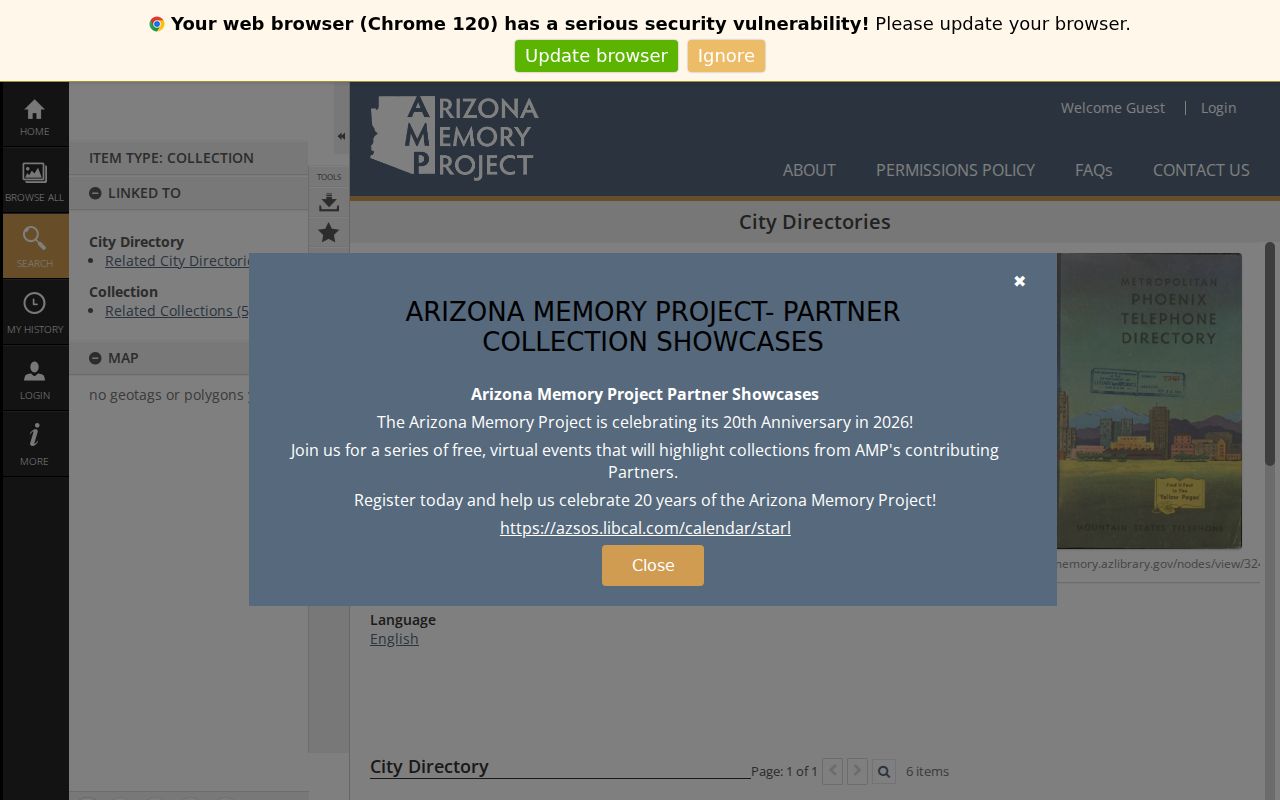
The image shows why collection metadata and page images should be used together: the catalog identifies the book, while the scanned legend and divisions explain each entry.
Trace Queen Creek Families Across Years
A careful family-history search moves between sources instead of treating one city directory line as final proof. The 1950 federal census supplies a household anchor before the verified Queen Creek editions. Each later directory can then show whether the same surname, spouse, work clue, or address persists. The 1974 telephone book extends the trail after the ConSurvey series.
- Find the surname in the 1950 census, using enumeration-district maps when rural OCR search fails.
- Search the 1958 alphabetical section and record each spelling, spouse, occupation, address, telephone number, and status mark.
- Compare the 1960 and 1963 editions, then check the street division for address order and nearby names.
- Continue into the 1974 white pages, local newspapers, deeds, probate files, and class photographs.
- Label each fact by source, such as directory-listed householder, census household, or recorded owner.
A disappearance can reflect a move, death, marriage-name change, omission, or a publisher's changing survey area. It does not prove departure. Two independent sources are stronger than a name match alone, especially when relatives reuse given names.
Queen Creek Directory Place Names
Queen Creek incorporated on September 5, 1989, so earlier evidence often sits under county systems or old community names. The farm settlement was called Rittenhouse for its railroad spur. Local history places the Queen Creek name change in 1947, while Rittenhouse School kept the older name. Chandler Heights, Higley, and Combs also belong in a complete index search.
Search the same surname with each place term. Add Ellsworth, a known farm, an employer, or a rural route when available. A broad newspaper or directory database may index the regional title but miss “Queen Creek” in page text. Place-name variants recover records without assuming all nearby entries fell inside today's Town boundary.
Search tip. Run Rittenhouse, Chandler Heights, Higley, and Combs separately, then confirm the place from the scanned page rather than search snippets.
Queen Creek Library Directory Access
Queen Creek Library is the shared local access point for residents on either side of the county line. All incorporated Town residents qualify for a free Maricopa County Library District card regardless of county. The branch provides in-library Ancestry Library Edition, HeritageQuest, Newspapers.com coverage, ProQuest Newsstreams, and Arizona Republic access from 1999.
The branch opened in 2008, so it should not be described as an uninterrupted physical directory archive. Confirm a title before traveling. For deeper shelf work, the State Research Library in Phoenix holds print and microform directories, yearbooks, and genealogy aids. Its Reading Room operates by appointment on weekdays. A remote request may cover up to three directory years or a two-week newspaper window, though results are not guaranteed.
Digital access, a local library visit, a State Library appointment, and a focused remote request form the full access chain. Scan-to-email or cloud options may reduce copy needs at the State Library.
Prepare a compact request before contacting staff. Include the full name and spelling variants, a known spouse or employer, the street or rural route, likely community names, and no more than three target years for State Library remote work. Ask whether the answer came from a print volume, microfilm, licensed database, or scanned page. A citation with title, edition, page, and repository makes the clue repeatable and helps another researcher distinguish a catalog hit from the actual entry.
Rittenhouse School Preserves Community Lives
The Old Rittenhouse School and San Tan Historical Society add the human evidence that formal directories miss. The school opened in 1925, gained a federal-funds addition in 1936, and stopped serving as a school in 1982. Its preservation history includes state and national register recognition.
The society's Vinnie Russo Memorial Arizona History Library holds more than 1,200 books. Class photographs begin in 1926. Oral histories, farm-community records, the Sue Sossaman history manuscript, founding-family material, and a guest register can connect names with local events. The museum at 20425 South Ellsworth Road is free on Saturdays from 9 a.m. to 1 p.m.; tours are available by request. It supplies context, not certified deeds or vital certificates.
Bridge Queen Creek Directory Gaps
No verified Queen Creek Sanborn fire-insurance sheet appears in Arizona State University's authoritative index. The better local substitute is the 1946 seven-sheet “Arizona Physical Land Conditions, Queen Creek Soil Conservation District” map. It records the agricultural landscape across Maricopa and Pinal counties before incorporation. The State Archives holds a much wider map collection from the 1860s forward.
Newspapers can fill social and date gaps. Search a personal name beside Rittenhouse, Queen Creek, Chandler Heights, Higley, Combs, Ellsworth, or a known farm. Obituaries, school lists, wedding notices, land notices, and community columns are leads. Confirm a legal event with the clerk or recorder. For current address-keyed work, the Queen Creek street directory follows parcels and recorded land documents rather than rebuilding the historical collection.
Note: The historical society, library, archive, and digital collection complement one another, but each holds a different kind of evidence.